
BarndoBible.com is reader-supported. When you buy through links on our site, we may earn an affiliate commission at no extra cost to you. We only recommend products we’d use ourselves.
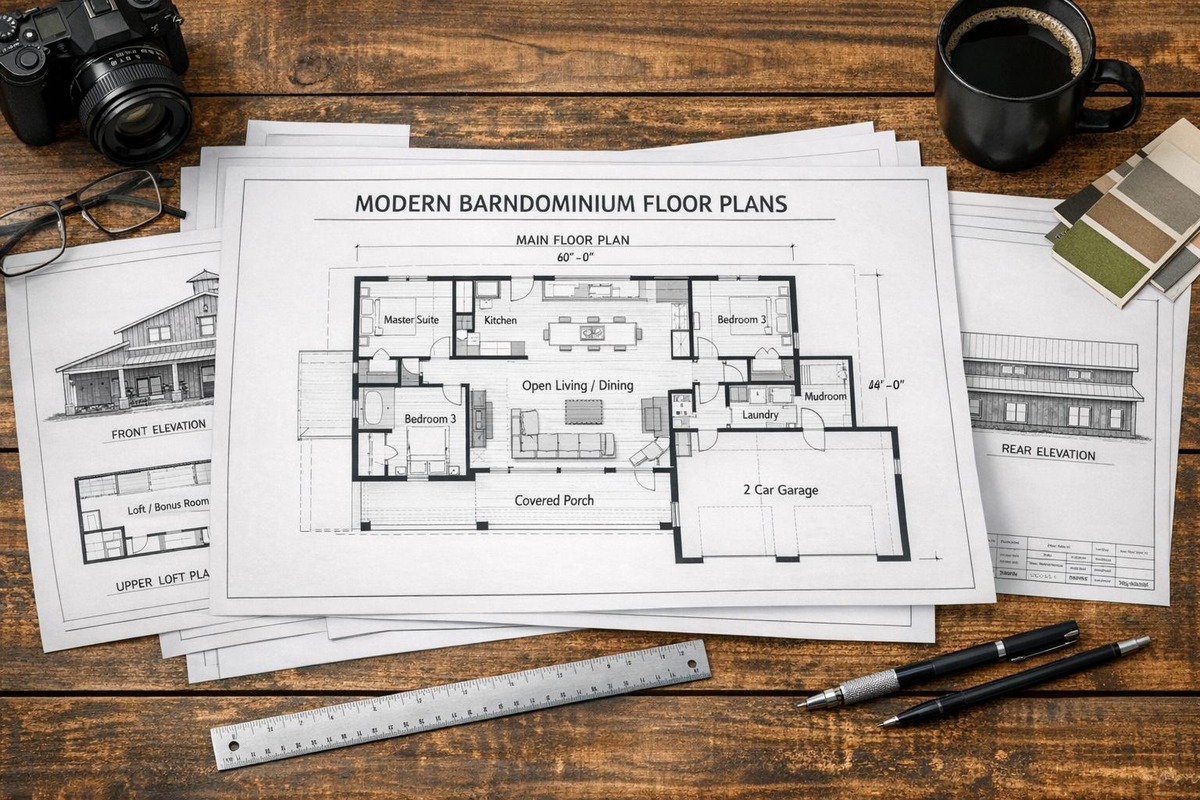
Barndominium floor plans are where most projects stall. You know roughly what you want — a big open kitchen, a master suite, space for a shop — but translating that into a buildable plan that works with a steel kit is harder than it looks. This guide walks through the most popular layouts, what makes each one work, and what your plan needs to include before any kit company will give you an accurate quote.
What Makes a Barndominium Floor Plan Different
A barndominium floor plan isn’t just a house plan dropped inside a metal shell. The structural system changes what’s possible. In a steel-frame barndominium, the exterior walls carry the load — which means interior walls are non-structural partitions. You can place them almost anywhere, move them later, or eliminate them entirely. That’s the open floor plan advantage that makes barndominiums so popular.
The tradeoffs: ceiling heights are determined by the kit (typically 10-14 ft on the eave, higher at the ridge), window and door openings need to be specified before the steel is ordered, and HVAC ductwork — if you’re using it — needs to be planned before framing. Changes after the kit is ordered cost money. Changes after the slab is poured cost a lot of money.
Rough-in decisions start at the floor plan stage
Panel location, plumbing wall layout, and HVAC routing get locked in when you draw your floor plan — and they’re the most expensive things to fix after drywall goes up. Our free Rough-In Checklist covers every electrical, plumbing, and HVAC line item so you can plan them into your layout from day one.
The Four Most Popular Barndominium Layout Types
1. Open Concept Living + Attached Shop
The most common barndominium configuration. Living space occupies one end or one side of the building; the shop or utility bay occupies the other. A single roofline covers both. The interior connection between living and shop is typically a fire-rated door.
Best for: Hobbyists, small farmers, anyone who wants covered parking and work space without a separate outbuilding.
Typical size: 40×60 to 50×80 (living: 1,200-2,000 sq ft + shop: 800-1,600 sq ft)
Key planning note: Insulate and climate-control the living side only. The shop gets basic insulation to prevent condensation but not full HVAC.
2. Full Residential, No Shop
The entire footprint is conditioned living space. More common in suburban-adjacent areas where a large shop would trigger zoning issues, or for buyers who want maximum livable square footage per dollar.
Best for: Families prioritizing living space over work space, downsizers moving from a traditional home.
Typical size: 40×60 to 50×80 (2,400-4,000 sq ft fully finished)
Key planning note: Without a shop bay, the cost-per-square-foot advantage of a barndominium narrows. You’re paying for metal construction without the hybrid-use benefit. Still cheaper than stick-built, but the gap is smaller.
3. Apartment Over Shop (Two-Story)
Living quarters on the second floor or mezzanine level, shop or equipment storage below. Popular for agricultural operations where the land has an existing home but needs a working facility, or as a guest quarters / rental unit over a large shop.
Best for: Agricultural properties, rental income setups, phased builds where you live in the apartment while building the main house.
Typical size: 40×60 to 60×80 footprint, 800-1,400 sq ft living area upstairs
Key planning note: Second-floor living requires engineered floor systems and a more complex kit. Financing is harder — some lenders won’t touch a “shop with apartment.” Budget 15-20% more than a comparable single-story build.
4. Split Bedroom Open Concept
The master suite on one end, secondary bedrooms on the other, great room in the middle. No shop component — this is a pure residential layout optimized for privacy and flow. The most “house-like” of all barndominium configurations.
Best for: Families with children, anyone prioritizing bedroom separation and a traditional residential feel.
Typical size: 40×60 to 50×80 (2,400-4,000 sq ft)
Key planning note: The split bedroom layout works well in a rectangle but can feel choppy in a square footprint. Rectangular buildings (2:1 or 3:2 ratio) give you more design flexibility.
Sample Floor Plans by Size
2,000 Sq Ft: 40×60 with 800 Sq Ft Shop (3 Bed / 2 Bath)
One of the most popular barndominium configurations in the country. The 40×60 footprint is a sweet spot — large enough for a comfortable 3-bedroom home plus a functional shop, small enough to keep kit and foundation costs reasonable.
| Zone | Square Footage | Key Features |
|---|---|---|
| Master suite | 280 sq ft | Walk-in closet, ensuite bath with tile shower |
| Bedrooms 2 & 3 | 220 sq ft each | Shared hall bath |
| Great room (kitchen/dining/living) | 700 sq ft | Open concept, 12-ft ceilings, island kitchen |
| Utility/mudroom + laundry | 120 sq ft | Connects to shop entrance |
| Shop bay | 800 sq ft | 14-ft eave height, 12-ft roll-up door, 100-amp subpanel |
| Covered porch | 200 sq ft | Front entry, optional back porch |
Estimated build cost (mid-grade, owner-builder GC, rural Texas): $190,000-$260,000 including well and septic. See the full cost guide for a complete budget template.
2,400 Sq Ft: 40×60 Full Residential (4 Bed / 2.5 Bath)
The full 40×60 footprint devoted to living space. Four bedrooms, split layout, large open great room. This configuration competes directly with a traditional 4-bedroom home at significantly lower cost per square foot.
| Zone | Square Footage | Key Features |
|---|---|---|
| Master suite | 360 sq ft | Dual walk-in closets, soaking tub + tile shower |
| Bedrooms 2, 3 & 4 | 180 sq ft each | Two share a jack-and-jill bath |
| Great room (kitchen/dining/living) | 900 sq ft | 14-ft vaulted ceiling, large island, dining for 8 |
| Office / flex room | 160 sq ft | French doors off great room |
| Utility + laundry + half bath | 160 sq ft | Rear entry mudroom |
| Covered porches | 400 sq ft | Front and back |
3,000 Sq Ft: 50×60 with 1,200 Sq Ft Shop (3 Bed / 2 Bath + Office)
The step up to a 50-wide building opens up significant design flexibility — wider great rooms, larger master suites, and a shop bay that can fit two full-size trucks side by side. This is the most popular size among serious rural owner-builders.
| Zone | Square Footage | Key Features |
|---|---|---|
| Master suite | 420 sq ft | Oversized closet, freestanding tub, walk-in tile shower |
| Bedrooms 2 & 3 | 240 sq ft each | Shared bath with double vanity |
| Home office | 180 sq ft | Separate entry option from mudroom |
| Great room (kitchen/dining/living) | 960 sq ft | 16-ft ceiling at ridge, exposed trusses, large island |
| Utility + laundry + half bath | 160 sq ft | Dog wash, extra storage |
| Shop bay | 1,200 sq ft | 16-ft eave, two 12-ft roll-up doors, full 200-amp service |
Estimated build cost (mid-grade, owner-builder GC, rural Texas): $280,000-$380,000 including well and septic. Use the square footage planner to adjust these room sizes to match your priorities and see how different configurations affect your total footprint.
What Your Floor Plan Must Include Before Getting a Kit Quote
Kit companies can’t give you an accurate quote from a sketch on a napkin. Here’s what needs to be defined before you approach a supplier:
- Overall building dimensions (width x length) — affects every structural calculation
- Eave height — standard is 10-12 ft for residential, 14-16 ft for shop bays
- Roof pitch — 2:12 to 4:12 is standard for metal buildings; steeper pitches cost more
- Door and window locations and sizes — rough openings must be specified at order
- Roll-up door sizes — 10×10 vs. 12×14 affects the structural header design
- Lean-to or porch additions — any attached structure must be included in the kit design
- Interior load-bearing walls — almost never needed in a steel frame, but confirm with your engineer
- Insulation liner panels — some kits include them, some don’t; decide before ordering
Spec what goes inside the walls with the same discipline
Everything on the list above has to be specified before the steel is ordered — and everything inside your walls has to be specified before drywall. The Rough-In Pack is the complete pre-drywall system: the 88-item checklist in inspection order, sub-hiring question sheets for electrical, plumbing, and HVAC, and a rough-in budget worksheet.
Custom Plans vs. Standard Plans: Which Is Right for You?
Most kit companies offer both. Standard plans are pre-engineered configurations — they’re faster to quote, cheaper to engineer, and faster to permit because the structural calculations are already done. Custom plans let you specify exact room dimensions, ceiling heights, and opening locations, but add $3,000-$8,000 in engineering costs and 4-8 weeks to the timeline.
For most first-time builders, a standard plan modified to your needs is the right choice. The modifications that matter most — interior partition layout, finish level, porch additions — don’t require custom engineering. The modifications that do require it (non-standard eave heights, unusual roof pitches, large clear-span openings) are worth the engineering investment if you genuinely need them.
Before you finalize any floor plan, it’s also worth checking that your target land can actually support your intended footprint — setback requirements, septic siting, and topography all constrain where and how big you can build. Our land buying guide walks through exactly what to evaluate before making an offer.
Some kit suppliers, like DC Structures, include design consultation and engineering stamps in their packages — a significant advantage for first-time builders who don’t know what they don’t know. Others, like General Steel, offer a large library of standard configurations at competitive pricing for buyers who know exactly what they want.
Frequently Asked Questions
What is the most popular barndominium floor plan size?
The 40×60 footprint (2,400 sq ft total) is the most popular size for barndominium builds in the US. It’s large enough for a 3-4 bedroom home or a 2-3 bedroom home with an 800-1,000 sq ft shop, while keeping kit and foundation costs in the $30,000-$55,000 range for the building materials alone.
Can I design my own barndominium floor plan?
Yes — and you should start with a sketch of your own before talking to any kit company. Knowing your must-haves (number of bedrooms, shop size, porch orientation) and your nice-to-haves (home office, mudroom, walk-in pantry) helps you evaluate standard plans intelligently. However, for permit-ready construction documents you’ll need a licensed architect or engineer to produce stamped drawings. Many kit companies include this in their packages.
How do I know if a floor plan will work with a steel kit?
Any rectangular floor plan works with a standard steel kit. The constraints are: overall dimensions must be in standard increments (usually 5-ft or 10-ft modules), door and window openings must be specified before fabrication, and any attached structures (porches, lean-tos) must be engineered as part of the kit. An experienced kit supplier will flag incompatibilities when you submit your design for quoting.
What’s the minimum size for a barndominium to be considered a home?
Most counties require a minimum of 600-1,000 sq ft of conditioned living space to classify a structure as a single-family residence. The specific requirement varies by jurisdiction. A 30×40 building (1,200 sq ft) with 800 sq ft of living space comfortably meets minimum requirements in most rural counties, but verify with your local building department before committing to a footprint.
Once you have a floor plan concept in mind, the next step is getting kit quotes tied to your actual dimensions — reach out to a couple of suppliers to compare design support and pricing on standard sizes. Have your overall dimensions and eave height ready before you call.