
BarndoBible.com is reader-supported. When you buy through links on our site, we may earn an affiliate commission at no extra cost to you. We only recommend products we’d use ourselves.
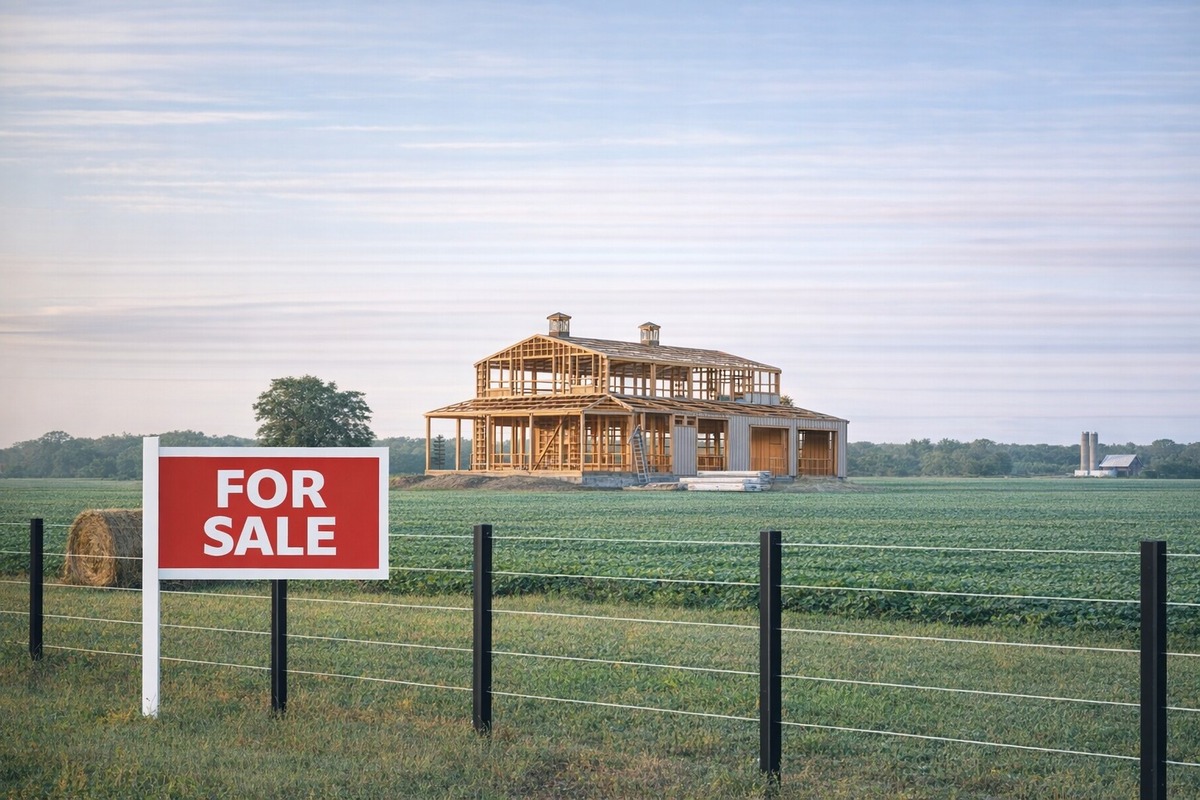
Buying land for a barndominium is not the same as buying a residential lot. The due diligence checklist is longer, the gotchas are less obvious, and the mistakes are more expensive — because unlike a bad kitchen choice, you can’t fix a bad piece of land after you’ve closed on it. This guide covers every material factor to evaluate before you make an offer, in the order you should check them.
Start Here: The Four Things That Kill Barndominium Projects on Rural Land
Before you fall in love with a piece of property, verify these four things. If any of them is a dealbreaker, find out before you spend money on surveys, soil tests, and attorneys.
- Zoning prohibits a metal building as a primary residence — more common in suburban-adjacent counties than true rural areas
- Deed restrictions or HOA covenants ban metal buildings — read the deed and any recorded plat restrictions before anything else
- The land won’t perc — failed septic percolation test means no septic, which means no buildable site without a very expensive engineered system
- No viable well water — deep water table or contaminated aquifer can make the site impractical to develop
You can check zoning and deed restrictions for free in an afternoon online. Perc and well viability take a site visit and a licensed contractor. Do the free checks first.
Just starting your land search? Grab the free Starter Kit
The free Barndominium Starter Kit bundles the complete planning checklist, a budget template with well and septic line items built in, a 12–18 month timeline roadmap, and a zoning and legal guide — everything to organize your land search and build plan in one download.
Zoning: What to Look For
Most rural barndominium builds happen on land zoned Agricultural (AG), Rural Residential (RR), or in truly unzoned counties. These classifications generally allow metal buildings as primary residences with minimal restrictions.
Problems arise in areas that are zoned Residential (R-1, R-2) or Suburban Residential — these classifications often require homes that meet specific aesthetic standards, which a metal building may not satisfy. Some counties have “metal building overlay” ordinances that require brick or stone facades on any structure visible from a public road.
How to check zoning in 5 minutes: Search “[county name] GIS zoning map” — most counties have an online parcel viewer where you can look up any parcel’s zoning classification by address or parcel number. Then search “[county name] zoning ordinance” and look up the permitted uses for that classification. If you can’t find it online, call the county planning and zoning office directly — they’ll tell you in 2 minutes whether a barndominium is allowed.
Deed Restrictions and HOA Covenants
Zoning is set by the county. Deed restrictions are set by previous landowners and run with the land regardless of what the county allows. A parcel can be zoned AG — theoretically allowing any structure — and still have a recorded deed restriction prohibiting metal buildings, manufactured homes, or structures below a minimum square footage.
How to check: Ask your title company or real estate attorney to pull the deed chain and identify any recorded restrictions or covenants. This is standard in any title search. If you’re evaluating a parcel before making an offer, the county clerk’s office has recorded deed restrictions on file — searchable by parcel number in most counties.
If the land is part of a subdivision or has a homeowners association, request the full CC&Rs (Covenants, Conditions and Restrictions) document before making any offer. Metal building restrictions are common in rural subdivisions that were platted in the 1990s and 2000s.
Soil Conditions: Reading the Land Before You Pay for a Test
Soil conditions affect two critical decisions: your foundation type and your septic system viability. You can get a preliminary read on both before spending money on professional testing.
Free Soil Evaluation: USDA Web Soil Survey
The USDA’s Web Soil Survey (websoilsurvey.sc.egov.usda.gov) maps soil types for every parcel in the US. Enter the address or navigate to the location, define the area, and run the Soil Data Explorer. Look for:
- Shrink-swell potential — high shrink-swell (common in Texas, Oklahoma, Kansas black clay) means you’ll need a post-tension or engineered slab, adding $8,000-$20,000 to your foundation cost
- Drainage class — “poorly drained” or “very poorly drained” soils cause septic problems and foundation moisture issues
- Depth to restrictive layer — shallow rock or hardpan limits septic trench depth and can make conventional septic systems impossible
Professional Soil Testing
If the Web Soil Survey raises concerns, or if you’re serious about a specific parcel, a geotechnical soil test ($500-$2,000) gives you precise bearing capacity data for foundation design. Your concrete contractor will likely require it before bidding a post-tension slab. Budget for it as part of your due diligence, not as a surprise after closing.
Well and Septic: The Rural Utility Question
Most rural barndominium sites have no municipal water or sewer. That means well and septic, which together add $12,000-$40,000+ to your project budget depending on conditions. Evaluating this before you buy land can save you from a very expensive surprise. Once you have your site conditions dialed in, use the barndominium financing estimator to model how well and septic costs affect your total loan amount and monthly payment.
Evaluating Well Viability
Contact your county’s groundwater conservation district or a local licensed well driller. Ask:
- What is the typical well depth in this area?
- What is the water quality like (hardness, iron content, any known contamination)?
- Are there any known issues with the aquifer in this township/section?
A well in central Texas might hit water at 80-120 feet for $6,000-$9,000. The same well in the Texas Hill Country granite might require 400+ feet and cost $20,000-$35,000. Local drillers know their area — a 10-minute phone call can tell you whether your target parcel is in good well territory or difficult well territory before you make any offer.
Evaluating Septic Viability: The Perc Test
A percolation test (perc test) measures how quickly soil absorbs water. The result determines whether a conventional septic system will work on the site, and if so, how large the drain field needs to be. A failed perc test doesn’t always mean the site is unbuildable — it may mean you need an engineered alternative system (aerobic, mound, or drip irrigation septic), which costs $8,000-$25,000 more than a conventional system.
Cost of a perc test: $200-$800 depending on state and county requirements. Some counties require perc testing before a building permit is issued anyway — getting it done during due diligence protects you before closing.
Who to call: Your county health department or a licensed septic installer. In most rural counties, the health department must approve the septic system design before a permit is issued — they can tell you exactly what’s required for your parcel.
Flood Zones: Check Before You Fall in Love
Building in a FEMA-designated Special Flood Hazard Area (SFHA — Zones A, AE, AH, AO, VE) has serious implications for your build. You’ll need flood insurance, your foundation must be elevated above the base flood elevation, and financing can be complicated.
How to check: Go to msc.fema.gov (the FEMA Map Service Center) and enter the address. This is a free, 2-minute check that should happen before you schedule any site visits. A parcel in a 100-year flood zone isn’t necessarily a dealbreaker — plenty of barndominiums are built on elevated pads in flood zones — but it changes your foundation design and adds cost.
Utilities: Electric Service and Propane
Rural electric service is not free to extend. If the nearest utility pole is 200 feet from your building site, you’re looking at $2,000-$4,000 for the hookup. If it’s a quarter mile away, that number can reach $15,000-$40,000. Call the local rural electric cooperative (not a city utility — rural land is almost always served by a co-op) and ask them for a line extension quote to the property. They’ll need a site plan showing where your meter base will be located.
Natural gas is rarely available on rural land. Propane is the standard alternative. A buried 500-gallon propane tank runs $400-$1,500 installed; a 1,000-gallon tank runs $800-$2,500. Factor this into your utility budget if you’re planning any gas appliances or a propane HVAC system.
Road Access and Driveway
Confirm the parcel has legal road access — either direct frontage on a public road, or a recorded easement across neighboring property. Landlocked parcels exist, and while they’re sometimes cheap for a reason, building on one without a legal access easement creates title problems and practical nightmares for construction equipment.
Estimate your driveway length from the road to your proposed building site. At $3-$8 per linear foot for a gravel driveway (plus culvert installation if you’re crossing a drainage ditch), a 400-foot driveway runs $1,200-$3,200 plus $800-$2,500 for the culvert. A half-mile driveway runs $8,000-$21,000. Long driveways are a real cost that online barndominium calculators almost never include.
The 20-Question Due Diligence Checklist
Before making any offer on rural land for a barndominium build, work through this list:
- What is the zoning classification? Does it allow a metal building as a primary residence?
- Are there any recorded deed restrictions or HOA covenants?
- What is the parcel’s soil type and shrink-swell potential (USDA Web Soil Survey)?
- Has a perc test been performed? What were the results?
- Is the parcel in a FEMA flood zone?
- What is the typical well depth and water quality in this area?
- How far is the nearest utility pole from the proposed building site?
- Which rural electric co-op serves this area? What is the line extension cost?
- Is natural gas available, or is propane required?
- Does the parcel have legal road frontage or a recorded access easement?
- How long is the driveway from the road to the building site?
- Is there a culvert needed to cross any drainage ditches?
- What is the topography — is the building site level, or will grading be required?
- Are there any easements crossing the parcel (utility, pipeline, drainage)?
- What is the county’s building permit process for new residential construction?
- Are engineering-stamped plans required for a permit in this county?
- What is the nearest town with reliable building material suppliers and subcontractors?
- Is the parcel in a fire district with required setbacks or defensible space requirements?
- What is the property tax classification (AG exemption available?)
- Has the seller disclosed any known issues with the property?
Take this checklist with you — plus the budget template and zoning guide
The free Barndominium Starter Kit packages this due diligence process into a printable planning checklist, and adds the budget template, timeline roadmap, and zoning and legal guide — so every question above gets answered before you sign anything.
Where to Find Rural Land for a Barndominium
Barndominium-friendly land — zoned AG or rural residential, already cleared or partially cleared, with existing utility access — is the difference between a $15,000 site prep budget and a $50,000 one. Filtering land searches by these criteria saves time and money. Once you find a parcel that passes this checklist, review our barndominium floor plans guide to confirm your target building footprint will fit the site and meet your setback requirements.
LandWatch is a comprehensive rural land listing platform, with county-level filtering that lets you identify parcels with existing road frontage, utilities, and clearing. LandSearch aggregates listings across multiple MLS systems and is particularly strong in the South and Midwest where most barndominium builds happen.
Frequently Asked Questions
How many acres do I need for a barndominium?
Minimum lot size for a barndominium with well and septic is typically 1-3 acres in most rural counties, depending on soil conditions and required septic setbacks. The septic drain field is usually the controlling factor — poorly draining soil requires a larger field, which requires more land. Practically speaking, 3-5 acres gives you comfortable setbacks, room for a driveway, and space for future outbuildings without feeling cramped.
Can I build a barndominium on agricultural land?
Yes — AG-zoned land is typically the most barndominium-friendly zoning classification. Most AG zones allow residential structures as a permitted use, including metal buildings. Some counties require the parcel to be actively farmed or ranched for an AG classification to apply, but in practice this is rarely enforced for residential builds. Confirm with your county’s planning office.
What is the cheapest state to buy land for a barndominium?
Rural land in Oklahoma, Missouri, Arkansas, Kansas, and west Texas offers the lowest per-acre prices for barndominium-suitable parcels — typically $1,500-$5,000 per acre for unimproved rural land. Central and east Texas runs $3,000-$8,000 per acre. The Southeast (Tennessee, Georgia, North Carolina) runs $5,000-$15,000 per acre for rural parcels with road frontage. Land in Colorado, the Pacific Northwest, and the Northeast is significantly higher.
Should I buy land before getting a kit quote?
You don’t need to own land to get a kit quote, but you should have a target building size in mind before you evaluate land. The building footprint affects how much land you need (setback requirements are typically 25-50 ft from property lines), whether a level building site exists on the parcel, and whether your septic system can be sited with adequate separation from the building. Know your target footprint first, then evaluate land with that footprint in mind.
Once you’ve identified a parcel that passes this checklist, the next step is getting your building kit and floor plan dialed in. Browse rural land listings on sites like LandWatch or LandSearch, and use the barndominium cost guide to build a complete budget once you have your site conditions defined.