
How much does a barndominium cost? Most people researching this find a frustratingly wide range — ‘$50,000 to $500,000’ — without any explanation of what moves the number. This guide fixes that.
BarndoBible.com is reader-supported. When you buy through links on our site, we may earn an affiliate commission at no extra cost to you. We only recommend products we’d use ourselves.
The short answer: a finished barndominium costs $95-$175 per square foot in 2025-2026, or roughly $190,000-$350,000 for a 2,000 sq ft build. But that number is meaningless without understanding what’s included, what’s excluded, and which decisions control the final price.
Barndominium Total Cost by Square Footage
| Build Scenario | Cost Per Sq Ft | Estimated Total (2,000 sq ft) |
|---|---|---|
| Shell only (kit + erection) | $25-$45 | $50,000-$90,000 |
| Dried-in (shell + windows, doors, roof) | $45-$75 | $90,000-$150,000 |
| Owner-builder, mid-grade finish | $95-$130 | $190,000-$260,000 |
| Full-service contractor, mid-grade | $120-$175 | $240,000-$350,000 |
| High-end custom finish | $175-$250+ | $350,000-$500,000+ |
Pricing reflects 2025-2026 national averages. Labor costs in Texas, Oklahoma, and the rural Midwest typically run 10-20% below these figures. The Pacific Coast and Northeast run 20-40% above.
The Four Factors That Control Your Barndominium Cost
Before you look at a single line-item number, understand that four decisions determine roughly 80% of your final budget. Change any one of them and everything else shifts.
1. Square Footage — and What You’re Counting
The cost-per-square-foot figures you see online almost always refer to conditioned living space. If your barndominium includes a 1,200 sq ft shop bay that doesn’t need drywall, flooring, or HVAC, your blended per-square-foot cost drops significantly — but your total project cost doesn’t. Always budget by total footprint, then break out the finish level for each zone separately. See our barndominium floor plans guide for room-by-room breakdowns by building size that make this easier to visualize.
2. Finish Tier
The gap between a basic finish (LVP flooring, stock cabinets, builder-grade fixtures, painted drywall) and a high-end finish (polished concrete, custom cabinetry, quartz countertops, tile showers) is $40-$70 per square foot of living space. That’s $80,000-$140,000 on a 2,000 sq ft home. Decide your finish tier before you price anything else, and be honest with yourself — most people upgrade during the build, not downgrade.
3. Owner-Builder vs. Full GC
Acting as your own general contractor and performing hands-on finish work (drywall, painting, flooring, trim) saves most owner-builders $55,000-$90,000 on a mid-grade 2,000 sq ft build. None of those tasks require a license. All of them have a real learning curve. Budget extra time, not just extra money, if this is your first build.
4. Location and Site Conditions
Your zip code controls labor rates, permit fees, and code requirements. A barndominium on a level, already-cleared rural lot in central Texas will cost significantly less than the same building on a sloped, wooded lot in western North Carolina — even if you use the same kit from the same supplier. Site-specific costs (clearing, grading, well, septic, driveway) are where rural builds routinely blow their budgets. Before you buy land, read our guide on what to check before making an offer on rural property — the site conditions you discover in due diligence directly set this cost category.
Barndominium Cost by State
State-level costs diverge more than most national figures admit. Frost depth changes your foundation, seismic and snow loads change your engineering, and permit regimes range from a single county form to a full plan review. These guides break the numbers down state by state:
- Cost to build a barndominium in North Carolina
- Barndominium cost per square foot in Wisconsin
- Barndominium cost in Utah
- Barndominium construction costs in Arkansas
- Barndominium cost per square foot in Oklahoma
- Barndominium cost per square foot in Nebraska
- How much does a barndominium cost in Texas
Steel Kit and Shell Costs
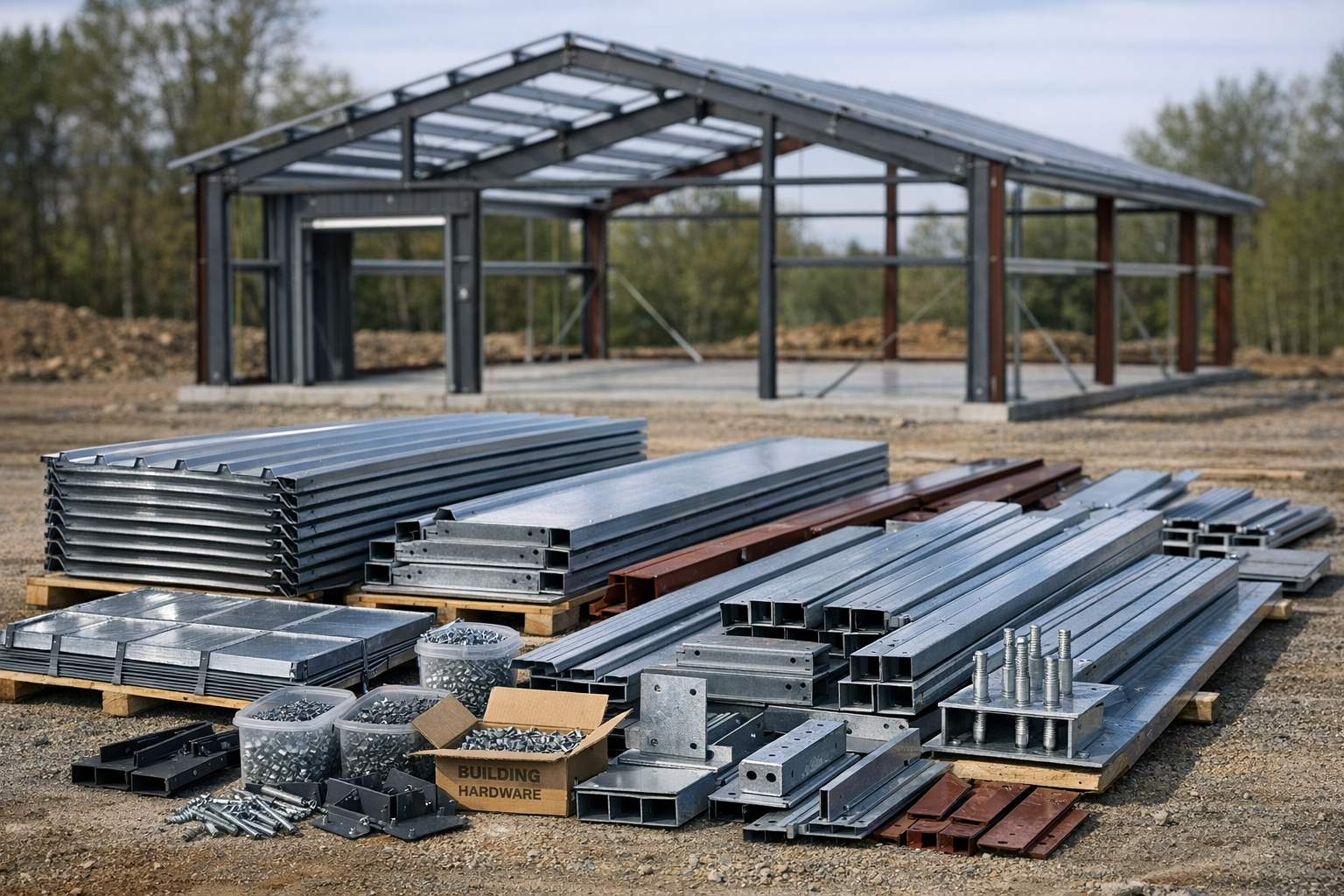
The steel building kit is the most visible barndominium expense — and consistently overestimated as a share of total project cost. In reality, the kit represents 15-25% of a finished barndominium’s total cost. The rest is everything that happens after the steel goes up.
| Building Size | Footprint | Budget Kit | Mid-Grade Kit | Premium Kit |
|---|---|---|---|---|
| 30×40 | 1,200 sq ft | $16,000-$22,000 | $24,000-$32,000 | $34,000-$44,000 |
| 40×60 | 2,400 sq ft | $26,000-$36,000 | $38,000-$52,000 | $55,000-$72,000 |
| 50×80 | 4,000 sq ft | $40,000-$56,000 | $58,000-$78,000 | $82,000-$108,000 |
| 60×100 | 6,000 sq ft | $58,000-$80,000 | $84,000-$112,000 | $115,000-$150,000 |
Erection costs (raising the shell, not included in kit price): $3-$8 per square foot of building footprint. For a 40×60, add $7,200-$19,200 in labor if you’re not raising it yourself.
Kit suppliers vary widely on what’s included. Some, like DC Structures, bundle engineering stamps and design consultation into the package — a real advantage for first-time builders who don’t want to coordinate a separate structural engineer. Others, like General Steel, focus on a large library of standard configurations at competitive pricing for buyers who already know their specs. Get quotes from at least three suppliers before committing, since pricing and inclusions vary significantly.
Foundation Costs
Foundation is the most underestimated line item in most first-time barndominium budgets. On rural land with variable soil conditions, it can easily become your largest single cost outside of the building kit itself.
| Foundation Type | Cost Per Sq Ft | Total Cost (2,400 sq ft) | Best For |
|---|---|---|---|
| Monolithic slab | $5-$10 | $12,000-$24,000 | Level sites, stable soil |
| Pier and beam | $8-$15 | $19,200-$36,000 | Sloped land, flood zones |
| Post-tension engineered slab | $10-$18 | $24,000-$43,200 | High-clay soils (required in many TX/OK counties) |
| ICF stem wall + slab | $12-$22 | $28,800-$52,800 | Extreme climates, best thermal performance |
| Full basement | $20-$40 | $48,000-$96,000 | Northern states, primarily |
If you’re building on Texas black clay, Oklahoma red clay, or Kansas expansive soils, a standard monolithic slab is not adequate. You need a post-tension or engineered slab. For maximum thermal efficiency, BuildBlock ICF forms are worth serious consideration for the stem wall.
Roofing Costs
| Roof Type | Installed Cost Per Sq Ft | Lifespan | Notes |
|---|---|---|---|
| Exposed fastener (R-panel / PBR) | $3.50-$6.00 | 25-35 years | Lowest cost, common on shop sections |
| Standing seam | $7.00-$14.00 | 40-70 years | Best long-term value, no fastener leak points |
| Stone-coated steel | $10.00-$16.00 | 40-50 years | Traditional appearance, higher cost |
The standing seam premium is worth it on the residential portion of your build. Many builders use R-panel on the shop and standing seam on the house — a smart cost split if your design separates those zones clearly.
Mechanical Systems: Electrical, Plumbing, and HVAC
Mechanical systems are where most barndominium budgets experience the biggest surprises. Combined, these three systems typically represent 25-35% of total project cost. Before your trades break ground, grab our free barndominium rough-in checklist — it covers the sequencing and steel-building-specific mistakes that turn a $200 fix into a $2,000 one once drywall goes up.
Electrical
| Line Item | Typical Cost |
|---|---|
| 200-amp service entrance and meter base | $1,800-$3,500 |
| Rough-in wiring (per sq ft of living space) | $3-$6 |
| Finish electrical (devices and fixtures) | $2-$4 per sq ft |
| 100-amp shop subpanel | $800-$1,800 |
| Total (2,000 sq ft home + shop) | $15,000-$28,000 |
Plumbing
| Line Item | Typical Cost |
|---|---|
| Rough-in plumbing (2 baths, kitchen) | $8,000-$15,000 |
| Fixtures (toilets, sinks, showers) | $2,500-$8,000 |
| Well and pump system (rural, no municipal) | $5,000-$15,000 |
| Septic system | $6,000-$20,000 |
| Total — well and septic, 2 bath | $22,300-$60,500 |
HVAC
| System Type | Installed Cost (2,000 sq ft) | Notes |
|---|---|---|
| Multi-zone mini-split | $8,000-$18,000 | Best for open plans, most efficient |
| Ducted central heat pump | $10,000-$22,000 | Better for closed room layouts |
| Propane furnace + central AC | $7,000-$14,000 | Common where natural gas is unavailable |
Insulation Costs
Insulation is the single decision that most affects long-term comfort and energy cost in a barndominium. Steel conducts heat and cold aggressively. Without a proper thermal break, a barndominium in Texas will be brutal in July regardless of your HVAC system size.
| Type | Installed Cost Per Sq Ft | R-Value | Notes |
|---|---|---|---|
| Fiberglass batts | $0.60-$1.20 | R-13 to R-21 | DIY-friendly, budget option |
| Open-cell spray foam | $1.00-$1.80 | R-3.7/inch | Good air sealing, lower cost |
| Closed-cell spray foam | $2.50-$4.50 | R-6.5/inch | Best overall performance, vapor barrier included |
| Rigid foam board (thermal break) | $0.50-$1.50 | R-4 to R-6.5/inch | Critical layer on metal wall panels |
The recommended approach: closed-cell spray foam applied directly to the interior face of the steel panels, followed by blown cellulose in any attic cavity. Spray foam is permanent once applied, so it should only go in after every rough inspection passes — our rough-in checklist walks through exactly what to verify before your foam contractor shows up. Home Depot stocks rigid foam board insulation and fiberglass batts for the DIY portions of your insulation package.
Interior Finish Costs
Flooring
| Type | Installed Cost Per Sq Ft | Notes |
|---|---|---|
| Polished concrete (existing slab) | $3-$8 | Lowest cost if slab was poured correctly |
| Luxury vinyl plank (LVP) | $3-$7 | Most popular choice, DIY-friendly, waterproof |
| Ceramic or porcelain tile | $6-$15 | Best for bathrooms and wet areas |
| Engineered hardwood | $6-$14 | Better over slab than solid hardwood |
LVP is the dominant flooring choice for barndominium living areas. It tolerates temperature swings, floats directly over concrete without a subfloor, and is waterproof. Lowe’s carries an extensive LVP selection in the $2-$5 per sq ft materials range.
Kitchen and Bathrooms
| Item | Budget | Mid-Grade | High-End |
|---|---|---|---|
| Kitchen cabinets (full kitchen) | $3,000-$6,000 | $8,000-$15,000 | $20,000-$50,000+ |
| Countertops | $1,500-$3,500 | $4,000-$8,000 | $10,000-$25,000 |
| Full bathroom (fixtures + tile) | $4,000-$8,000 | $10,000-$18,000 | $25,000-$50,000+ |
| Half bath | $1,500-$3,500 | $4,000-$7,000 | $9,000-$18,000 |
Complete Budget Template: 2,000 Sq Ft Barndominium
Mid-grade finish. Rural site with well and septic. Owner-builder acting as own GC. 2025-2026 pricing.
Want to run your own numbers instantly? Use the interactive barndominium cost calculator — adjust square footage, finish level, location, and builder type to get a real-time estimate with a full line-item breakdown.
Working out what to line up before the numbers matter? Our barndominium planning checklist walks the sequence from land through rough-in, so nothing lands on your budget as a surprise.
| Line Item | Low Estimate | High Estimate |
|---|---|---|
| Steel building kit (materials) | $28,000 | $45,000 |
| Kit erection labor | $7,200 | $16,000 |
| Foundation (post-tension slab) | $18,000 | $36,000 |
| Interior stud framing | $7,000 | $14,000 |
| Windows and exterior doors | $8,000 | $20,000 |
| Roofing (standing seam residential; R-panel shop) | $14,000 | $28,000 |
| Insulation (spray foam + blown-in hybrid) | $16,000 | $32,000 |
| Electrical (service + rough-in + finish) | $15,000 | $26,000 |
| Plumbing (rough-in + fixtures) | $12,000 | $22,000 |
| Well and pump system | $6,000 | $15,000 |
| Septic system | $7,000 | $20,000 |
| HVAC (multi-zone mini-split) | $9,000 | $17,000 |
| Drywall (materials + hired labor) | $8,000 | $16,000 |
| Flooring — LVP (materials + DIY install) | $4,000 | $9,000 |
| Kitchen cabinets and countertops | $12,000 | $24,000 |
| Bathrooms (2 full, 1 half — fixtures + tile) | $14,000 | $30,000 |
| Site work (clearing, grading, driveway) | $12,000 | $32,000 |
| Permits, plans, and soft costs | $6,000 | $18,000 |
| Contingency (10%) | $18,320 | $42,000 |
| PROJECT TOTAL | $201,520 | $462,000 |
Barndominium vs. Stick-Built Home: Full Cost Comparison
| Cost Category | Barndominium | Stick-Built Home | Barndo Advantage |
|---|---|---|---|
| Shell / framing | $25-$55/sq ft | $35-$65/sq ft | Modest savings |
| Foundation | $5-$18/sq ft | $5-$15/sq ft | Similar |
| Roofing | $7-$14/sq ft | $4-$9/sq ft (asphalt) | Stick-built wins short-term; barndo wins long-term |
| Mechanical (elec/plumb/HVAC) | $18-$35/sq ft | $20-$40/sq ft | Modest barndo savings |
| Interior finish | $20-$60/sq ft | $20-$65/sq ft | Similar |
| Total (mid-grade, 2,000 sq ft) | $120-$175/sq ft | $150-$250/sq ft | Barndo: 15-30% less |
| Shop / utility space | Included in structure | Separate outbuilding: $15,000-$60,000 | Barndo significant advantage |
How Much Can You Save by Owner-Building?
| Task | Hired-Out Cost | Owner-Builder Cost | Savings |
|---|---|---|---|
| General contractor markup (12%) | $24,000-$36,000 | $0 | $24,000-$36,000 |
| Drywall hang, tape, and mud | $12,000-$20,000 | $2,500-$4,500 | $9,500-$15,500 |
| Painting (interior, all surfaces) | $5,000-$9,000 | $700-$1,500 | $4,300-$7,500 |
| LVP flooring installation | $4,000-$8,000 | $400-$900 | $3,600-$7,100 |
| Interior trim and finish carpentry | $6,000-$12,000 | $1,200-$2,500 | $4,800-$9,500 |
| Total savings | $54,700-$91,400 |
Frequently Asked Questions
How much does a barndominium cost per square foot in 2025-2026?
A finished barndominium costs $95-$175 per square foot in 2025-2026 for most builds, depending on finish level and location. Owner-builders who act as their own GC and perform finish trades themselves typically land at $95-$130 per square foot. Full-service contractor builds with mid-grade finishes run $120-$175 per square foot. These figures include foundation, mechanical systems, insulation, and interior finish — not just the steel shell.
Is a barndominium cheaper to build than a traditional house?
Yes, typically 15-30% less expensive than a comparable stick-built home at mid-grade finish levels. The primary cost advantages are a faster-erecting steel shell, the ability to combine living space and shop/utility space under one roof, and lighter permit requirements in rural jurisdictions. The cost gap narrows in suburban markets with strict aesthetic codes or HOA requirements.
What is included in barndominium cost estimates?
Most credible barndominium cost estimates include the steel kit, foundation, framing, roofing, mechanical systems (electrical, plumbing, HVAC), insulation, and interior finish. What they frequently omit — and where rural builds get surprised — is site work (land clearing, grading, driveway), well and septic systems, utility hookup fees, permits and engineering plans, and the builder’s contingency. A realistic rural barndominium budget must include all of these categories or it will be wrong by $40,000-$80,000.
How much does a barndominium cost in Texas?
Texas runs below the national average — labor rates are lower, most rural counties permit lightly, and subcontractor competition is strong. But the spread between Central Texas, East Texas, the DFW exurbs, the Hill Country and West Texas is wide enough that a single statewide number misleads more than it helps. For regional ranges and a full breakdown, see how much does a barndominium cost in Texas.
How much does a barndominium shell cost?
A steel building kit (materials only) for a 40×60 barndominium typically runs $26,000-$52,000 depending on grade and supplier in 2025-2026. Add $7,200-$19,200 for professional erection. The delivered and erected shell represents 15-25% of the total finished project cost — which surprises most buyers who assume the building kit is the dominant expense.
How long does it take to build a barndominium?
An owner-builder managing their own GC duties on a 2,000 sq ft barndominium should plan for 12-18 months from permit approval to move-in. The steel shell erects in 3-7 days once the slab has cured. Interior finish is the longest phase for owner-builders doing significant work themselves — plan 4-6 months if you’re working nights and weekends around a full-time job.
The most useful next step is getting actual kit quotes tied to your target size and location — reach out to a few suppliers directly for pricing, since costs and included services vary significantly by company.