
Why Insulation Is the Most Important Decision After Your Kit
Barndominium insulation is the most under-researched part of most builds — and also one of the most expensive to get wrong. Metal buildings are thermal conductors. Without the right insulation system, your barndominium will be a furnace in summer, a freezer in winter, and a condensation nightmare year-round. Get it right and you’ll have a comfortable, energy-efficient home. Get it wrong and you’ll be dealing with moisture damage, mold, and sky-high energy bills for the life of the building.
This guide covers the most common insulation options for barndominiums, their pros and cons, R-value requirements by climate zone, cost ranges, and the mistakes you need to avoid.
The Core Problem: Metal and Condensation
Steel is a thermal bridge — it conducts heat and cold far more efficiently than wood. When warm, humid air hits a cold metal surface, you get condensation. In a barndominium, this can happen on the inside of your roof panels, your wall panels, and even your structural steel members. Over time, unchecked condensation causes rust, rot (in any wood components), mold, and insulation failure.
The right insulation system doesn’t just add R-value — it also creates a thermal break and controls moisture. This is why the insulation choices that work great in a wood-framed house don’t always work in a steel building.
The 4 Main Insulation Options for Barndominiums
1. Spray Foam Insulation (Open-Cell and Closed-Cell)
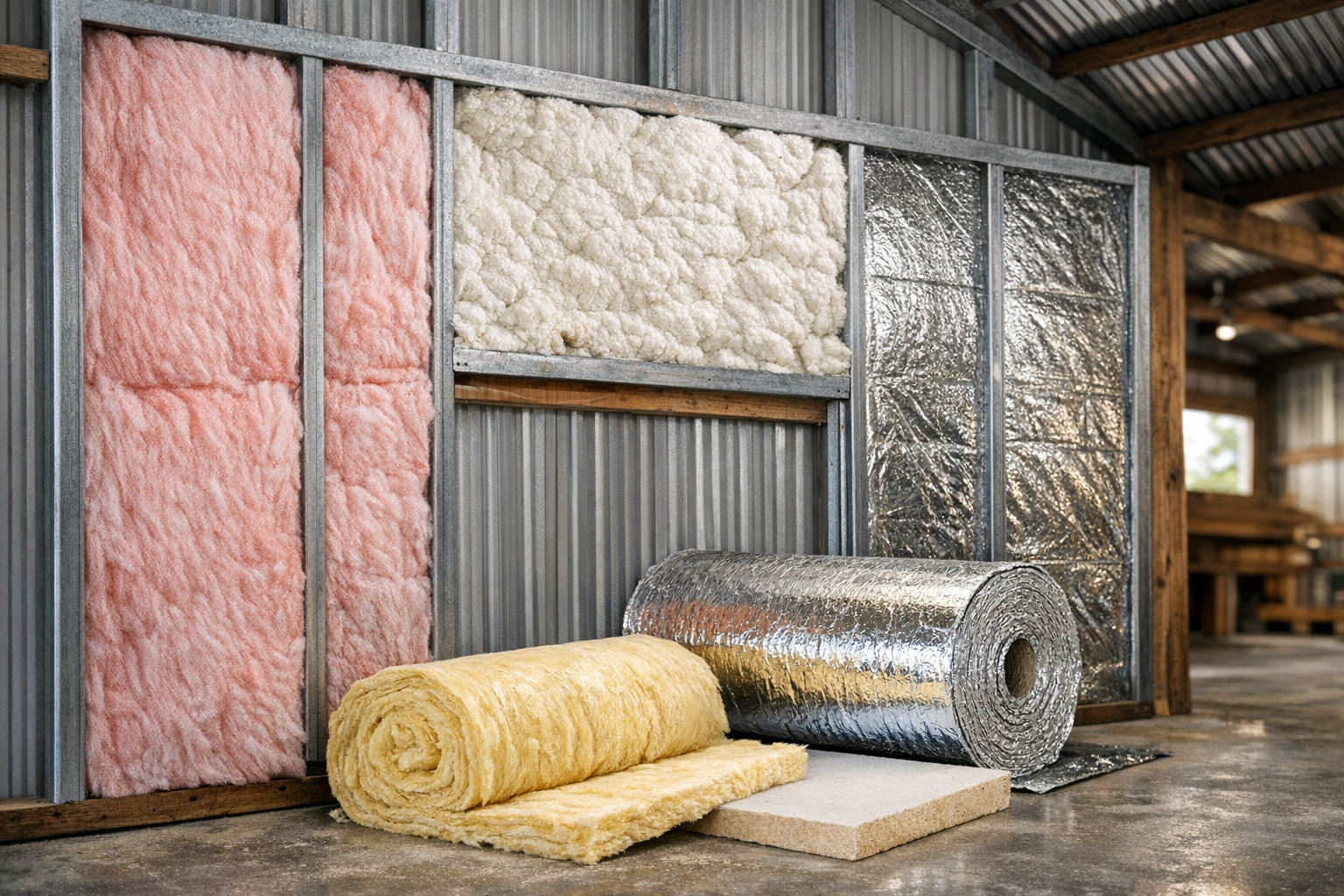
Spray polyurethane foam (SPF) is the gold standard for barndominium insulation, and for good reason. It adheres directly to your metal panels, expands to fill every gap, and creates both an air barrier and a vapor barrier in one application.
- Closed-cell spray foam is denser (2 lb/cu ft), provides higher R-value per inch (R-6 to R-7 per inch), and acts as a Class II vapor retarder. It’s the best choice for roofs and exterior walls in humid climates.
- Open-cell spray foam is lighter, less expensive, and provides about R-3.5 per inch. It’s a good option for interior walls and ceilings where moisture is less of a concern.
Cost: Closed-cell typically runs $1.50–$3.00 per board foot installed; open-cell runs $0.75–$1.50 per board foot. For a 2,000 sq ft barndominium, expect to budget $8,000–$20,000+ for a full spray foam job depending on your wall and roof height.
Best for: Hot/humid climates (Texas, Oklahoma, the Gulf South), any build where condensation control is a top priority.
2. Rigid Board Insulation (Polyiso, XPS, EPS)
Rigid foam board is installed between your girts and purlins before your interior finishing. It provides good R-value and a thermal break, though it doesn’t adhere to the metal the way spray foam does.
- Polyisocyanurate (Polyiso): Highest R-value per inch (R-6 to R-6.5), but performance decreases in very cold temps.
- Extruded Polystyrene (XPS): R-5 per inch, moisture resistant, commonly used in below-grade and high-moisture applications.
- Expanded Polystyrene (EPS): R-3.6 to R-4.2 per inch, least expensive, commonly used in SIP panels.
Cost: $0.25–$0.65 per square foot for the board itself. Installation adds labor; plan for $1.50–$3.00 per sq ft installed.
Best for: Dryer climates where condensation is less of a concern, or as part of a hybrid insulation system.
3. Fiberglass Batt Insulation
Standard fiberglass batts are the most familiar and least expensive insulation option. They’re available at every Home Depot and Lowe’s and are easy for DIYers to install. However, they perform poorly in steel buildings without additional vapor control measures.
The core problem: fiberglass batts don’t stop air movement, and they don’t adhere to metal. In a steel building, gaps between the batt and the metal panels allow warm air to reach cold surfaces — exactly the condition that causes condensation. If you use batts, you need a continuous vapor barrier on the warm side of the insulation, installed with zero gaps.
Cost: $0.30–$0.80 per sq ft for materials (R-13 to R-30 batts). This is the lowest material cost of any option, but factor in the vapor barrier and labor.
Best for: Interior partition walls, dryer climates with professional vapor barrier installation, or budget builds where spray foam isn’t feasible.
4. Reflective/Radiant Barrier Insulation
Reflective insulation (often called “bubble wrap insulation” or radiant barrier) is a common product sold specifically for metal buildings. It typically consists of a layer of polyethylene bubbles or foam sandwiched between two layers of foil facing.
Be careful here: reflective insulation is heavily marketed but frequently misunderstood. It works by reflecting radiant heat, not by providing conductive resistance (R-value). Most products have a tested R-value of only R-1 to R-3, despite marketing claims. It should be used as a supplement to a primary insulation system, not as a standalone solution.
Cost: $0.25–$0.75 per sq ft for materials. Often included in base steel kit packages as “vapor barrier” facing.
Best for: Use as a radiant barrier in attic spaces, or as a secondary layer combined with spray foam or rigid board.
R-Value Requirements by Climate Zone
Barndominium insulation requirements vary significantly by region. The International Energy Conservation Code (IECC) sets minimum R-value requirements based on climate zone. Most of Texas is in Climate Zones 2 and 3. Here are general targets for a conditioned barndominium:
| Climate Zone | States (Examples) | Minimum Wall R-Value | Minimum Roof R-Value |
|---|---|---|---|
| Zone 2 | South Texas, South Florida | R-13 | R-38 |
| Zone 3 | North Texas, Oklahoma, Georgia | R-20 | R-49 |
| Zone 4 | Tennessee, Virginia, Kansas | R-20 | R-49 |
| Zone 5 | Colorado, Indiana, Oregon | R-20 | R-60 |
Note: These are minimums. For a comfortable, energy-efficient barndominium, aim for R-values 20–30% above the minimum in your zone.
The Most Common Barndominium Insulation Mistakes
- Relying on reflective insulation alone. The “foil bubble wrap” included with many kits is not a complete insulation solution. It’s a vapor retarder and radiant barrier, not a primary insulation system.
- Skipping the vapor barrier with batts. If you use fiberglass batts in a metal building without a continuous vapor barrier on the warm side, you will get condensation. This is the #1 cause of mold in barndominium builds.
- Not accounting for thermal bridging at the girts and purlins. Even if your wall panels are well-insulated, the metal girts that run across them act as thermal bridges. Continuous rigid foam over the girts (before your interior finish) addresses this.
- Insulating the roof last. Roof insulation should be planned before you pour your slab — it affects roof panel selection, interior ceiling height calculations, and HVAC sizing.
- Getting spray foam quotes too late. Spray foam contractors book out fast, especially in spring and summer. Get on their schedule before your building is erected, not after.
- Foaming before rough inspections pass. Closed-cell spray foam is permanent \u2014 once it’s applied, correcting a failed electrical, plumbing, or HVAC inspection means cutting cured foam back out. Our free barndominium rough-in checklist lays out exactly what needs to be verified and signed off before your foam contractor starts.
Recommended Insulation System by Climate
Here’s how to combine the barndominium insulation options above into a complete system based on where you’re building:
- Hot/humid (Texas, Gulf South): 2″ closed-cell spray foam on all metal surfaces + open-cell or batt in framed interior walls. This is the most common and most effective system for this region.
- Mixed/moderate (Oklahoma, Carolinas, Tennessee): 1.5–2″ closed-cell on exterior metal + R-19 batts in framed walls with vapor barrier.
- Cold (Colorado, Midwest, Pacific Northwest): 2″+ closed-cell spray foam + additional rigid board or batt insulation to meet higher R-value requirements.
What to Buy at Home Depot or Lowe’s
If you’re handling any portion of your barndominium insulation as a DIY project, here are the products worth looking at:
- Fiberglass batts: Owens Corning EcoTouch and Johns Manville are reliable options. Available in standard stud widths (2×4, 2×6).
- Rigid XPS board: FOAMULAR by Owens Corning or Dow STYROFOAM are the most common brands. Buy in 4×8 sheets, available in multiple thicknesses.
- House wrap / vapor barrier: Tyvek HomeWrap or Typar BuildingWrap for wall assemblies. For vapor barriers, 6-mil poly sheeting is the standard.
- Can foam / gap sealant: Great Stuff Pro or Hilti CF for sealing penetrations, gaps around windows, doors, and electrical boxes.
Bottom Line
Getting your barndominium insulation right pays for itself many times over. For most barndominium builds in Texas and the South, closed-cell spray foam is worth every penny. It’s the most effective solution for condensation control, air sealing, and R-value in one product. If budget is a constraint, a hybrid system — spray foam on the exterior metal surfaces plus batts in framed interior walls — is a reasonable middle ground.
Whatever system you choose, plan it before you break ground. Your insulation choice affects your framing, your roof panel selection, your HVAC sizing, and your interior ceiling height. Don’t leave it as an afterthought.
Planning your full build budget? Use our free Barndominium Cost Calculator to factor your barndominium insulation costs in along with every other major cost category.