
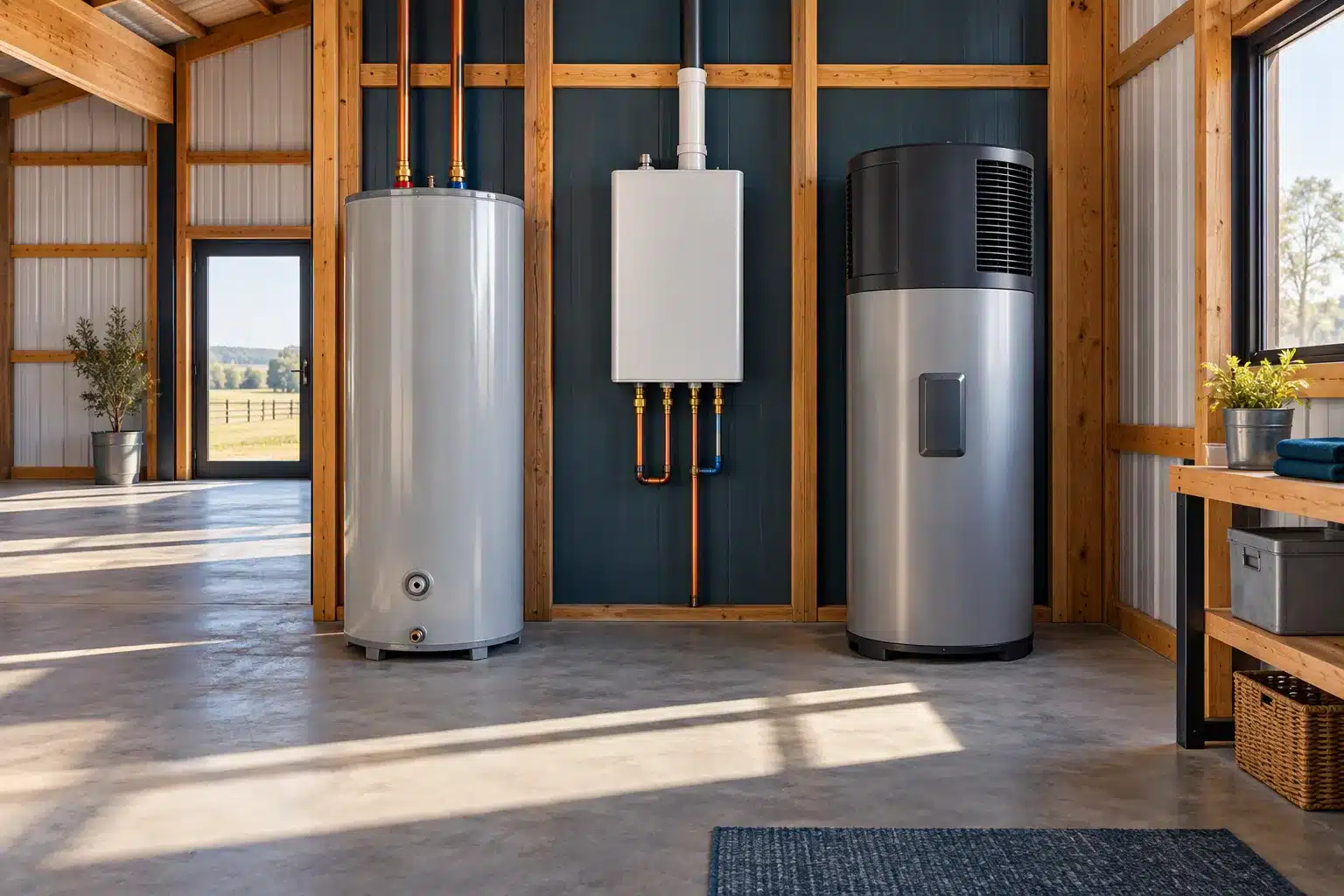
Choosing a barndominium water heater starts before you shop for a brand. Your available utilities, busiest hot-water periods, mechanical space, and installation budget all affect the decision. A small wall-mounted unit can still require substantial supporting work, while a tank needs space that should appear on the floor plan.
This guide compares electric and propane storage heaters, electric and propane tankless heaters, and heat-pump water heaters. Use it to narrow your barndominium water heater choices and request comparable quotes before rough-in.
Quick answer: which barndominium water heater belongs on your shortlist?
Start with three questions: What fuel and electrical capacity are available? How much hot water will you need at the same time? Where can the equipment be installed and serviced?
Keep a conventional storage model in the comparison as a baseline. Include a heat-pump model if its installation requirements can be met. Consider tankless after checking the specific model’s capacity and utility requirements. There is no single winner for every barndominium.
| Option | How it heats water | Question to resolve first |
|---|---|---|
| Electric resistance storage | Electric elements heat water held in a tank. | Does first-hour delivery meet peak demand, and what is the complete installed cost? |
| Propane storage | A propane burner heats stored water. | Are fuel supply and the model’s combustion and venting arrangements practical? |
| Electric tankless | Electric elements heat flowing water on demand. | Can the electrical system support the model while delivering the required flow and temperature rise? |
| Propane tankless | A propane burner heats flowing water on demand. | Can fuel delivery, venting, and maintenance needs be met? |
| Heat-pump storage | A heat pump moves heat from surrounding air into stored water; many models also have resistance elements. | Does the location provide suitable air, temperature, drainage, and service space? |
Storage and on-demand operation describe different heating approaches; fuel is a separate choice. Compare both. University of Florida Extension explains water-heater types and selection factors.
Size for hot-water use, not the home’s square footage
A floor area does not describe whether two showers, a laundry load, and a large tub will compete for hot water. Write down the combinations your household expects to use.
For a storage heater, look beyond tank gallons
The first-hour rating estimates how much hot water a fully heated storage unit can provide during an hour. It includes the unit’s ability to heat replacement water, so tank capacity alone is not the whole picture. Compare that rating with your busiest-hour demand. ENERGY STAR defines first-hour rating, flow rate, and efficiency measurements.
For tankless, check flow at the required temperature rise
Tankless selection depends on simultaneous flow and the increase needed from incoming-water temperature to the desired hot-water temperature. A headline maximum flow rate does not establish performance under every condition. Ask for the manufacturer’s sizing information for your actual application. Rinnai’s sizing guidance identifies flow, groundwater temperature, and temperature rise as key inputs.
Tankless equipment also has a capacity limit. For example, Stiebel Eltron describes how its Tempra Plus models reduce flow when demand exceeds heating capacity. That is a model-specific response, but it illustrates why “endless” hot water should not be read as unlimited simultaneous flow. See the manufacturer’s explanation of flow control.
Electric tankless: confirm the electrical plan before ordering
Ask the electrician to review the exact model’s power and circuit requirements alongside the home’s other loads. Keep the water-heater selection coordinated with the HVAC, kitchen, laundry, and shop plans. A panel’s label or the number of unused breaker spaces is not a substitute for that review.
Put any required service, panel, circuit, or utility work into the quote. A low equipment price does not tell you whether the complete installation fits your budget. Use the manufacturer’s current installation documentation for the selected unit rather than a generic online wiring diagram.
Heat-pump water heaters: reserve the right space
A heat-pump water heater deserves consideration alongside conventional tanks and tankless models. It moves heat from surrounding air into water rather than relying solely on resistance heating.
Before including one in a small closet, confirm the model’s air-volume or ventilation requirements, clearances, operating-temperature range, and condensate-drain arrangement. Its fan and compressor create sound, and its exhaust air is cooler and drier. Consider nearby bedrooms and living spaces when choosing the location.
Many hybrid models use resistance elements to help meet high demand. Compare capacity and operating modes as well as efficiency. Do not apply one room-size rule to every product. ENERGY STAR’s design guide covers location, sound, airflow, condensate, and sizing considerations.
Propane: include the supporting system in the comparison
If propane is already planned for other appliances, request a water-heating quote that identifies what additional work is needed. If it would serve only the water heater, request the complete fuel-system cost too.
Ask the installer to document fuel compatibility, supply capacity, combustion-air and venting requirements, and any condensate provisions for the proposed model. Compare the current delivered propane price and any tank or delivery charges with your actual electricity rate.
Do not assume a propane tankless heater works during an outage. Rinnai states that its electrically controlled tankless units need power. Check the exact equipment and any proposed backup arrangement. Rinnai’s FAQ addresses power interruptions.
Compare the complete cost, with the same assumptions
Request written barndominium water heater quotes against the same fixture list and expected demand. Separate these items so that an inexpensive appliance does not hide expensive supporting work:
- Equipment: exact model, controls, accessories, and delivery.
- Installation: plumbing, electrical work, fuel supply, venting where applicable, drainage, permits, and labor.
- Operating costs: model-specific estimated energy use and your local energy prices.
- Ownership: maintenance, service travel, parts availability, and warranty exclusions.
The EnergyGuide label offers standardized energy-use and operating-cost estimates. Its assumed rate may differ from yours. Compare the model information and local prices before treating the label’s dollar figure as your future bill. Review labor and parts coverage separately. University of Florida Extension discusses labels, operating costs, and warranties.
UEF measures efficiency under a defined test method; it is not an installed price or a household bill. ENERGY STAR explains Uniform Energy Factor. Ask that competing estimates use comparable demand assumptions. Treat any rebate or incentive as provisional until current eligibility is confirmed.
Plan maintenance and service access before closing walls
Keep the barndominium water heater accessible for inspection, maintenance, and eventual replacement. For a remote property, ask who services the proposed brand in your area and what a service visit costs.
Water quality can affect maintenance. Rinnai identifies periodic filter checks and flushing for its tankless units, with timing influenced by water quality. Follow the selected manufacturer’s requirements rather than assuming one schedule fits all heaters. See Rinnai’s maintenance guidance.
Include pipe routing and hot-water waiting time in the discussion. A centrally located barndominium water heater and shorter runs can help limit distribution losses. A recirculation system is another design decision to evaluate, not an automatic add-on. University of Florida Extension discusses location and recirculation.
Your barndominium water heater quote checklist
Copy this barndominium water heater list into your build notes and ask each bidder to answer it:
- What exact model and fuel are included?
- What household demand and incoming-water assumptions were used?
- What first-hour delivery or tankless flow performance is expected?
- What electrical or fuel-system work is included?
- What installation space, access, venting, and drainage are required?
- What local energy rates support the operating-cost estimate?
- What maintenance does the manufacturer require?
- Who provides local service, and what do parts and labor warranties cover?
- What is excluded from the quoted price?
Want the whole rough-in on one checklist?
The Barndominium Rough-In Pack is our paid checklist pack on Gumroad. It puts all 88 electrical, plumbing and HVAC rough-in checks for steel buildings in inspection order, including the well and septic tie-ins. Starts at $14. The $29 Owner-Builder Bundle adds the planning checklist, a budget worksheet and question sheets for hiring subs.
Make the choice before rough-in locks in the location
Shortlist two or three suitable configurations, then compare complete quotes. Choose equipment that fits the household’s demand and the building’s utility and space constraints. Record the model and its installation requirements in the plans before circuits, fuel lines, drains, and wall space are committed.
Continue planning with our rough-in checklist and mini-split versus ducted HVAC guide, or visit Start Here to organize the broader build.
This is a planning comparison, not a model-specific installation design. Equipment requirements and local approvals must be confirmed for the actual project. Sources reviewed October 18, 2026. Manufacturer references explain operating limits and requirements; they are not product endorsements.