
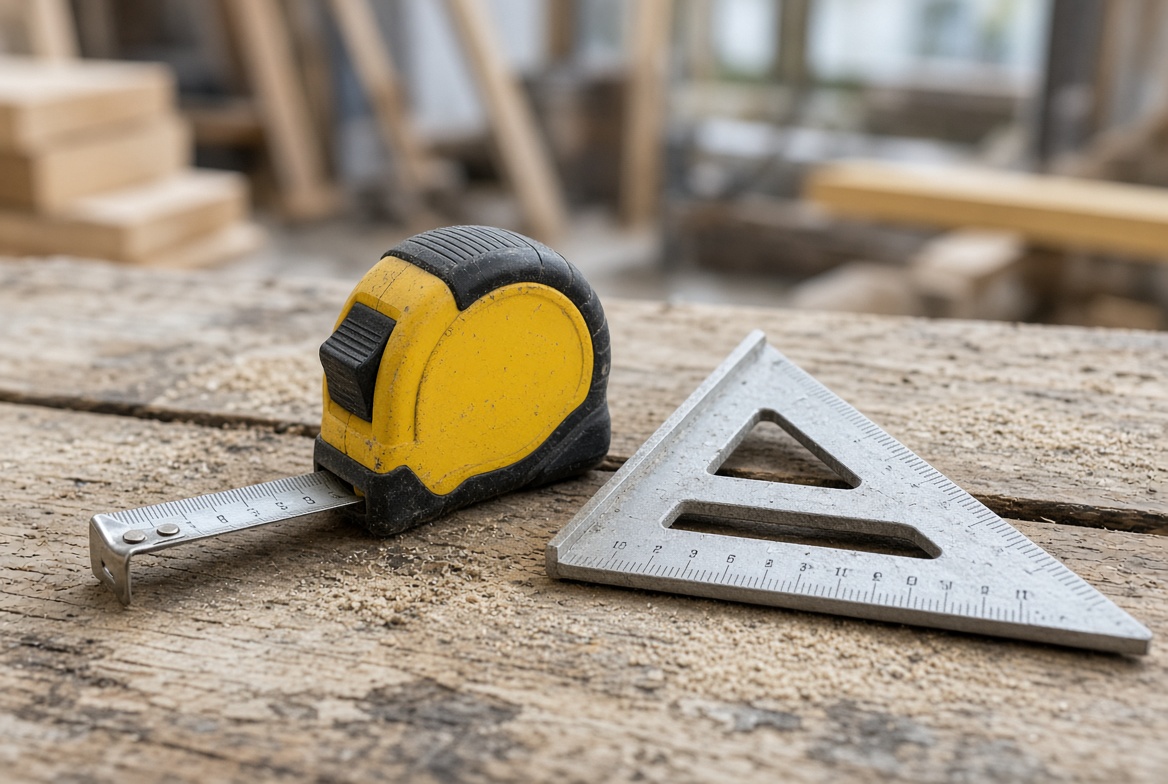
For most barndominium owner-builders, buy a dependable tape measure first. Add a laser measure when repeated room measurements justify it. A laser measure can make interior estimating easier, but it does not replace a tape for marking boards, checking small openings or transferring a dimension onto material.
Settling laser measure vs tape measure comes down to your next task. Measuring a finished room for flooring, marking a shelf and planning a driveway are three different jobs. This guide helps you choose a tool for each without buying equipment before you need it.
Last reviewed: October 14, 2026. This is a researched buying guide, not a hands-on product test. Our linked owner-builder tool guide contains affiliate recommendations and disclosures.
Laser measure vs. tape measure: choose by the job
| Task | Start with | What to check |
|---|---|---|
| Mark a board, shelf or trim piece | Pocket tape | Measure from the correct edge and mark the material directly. |
| Estimate flooring in an enclosed room | Laser measure, with tape for small details | Measure each zone; account for closets and recesses separately. |
| Check a door or window opening | Pocket tape | Use the supplier’s required measurement method and reference points. |
| Record room dimensions while working alone | Laser measure | A stable starting point and a suitable target are essential. |
| Compare preliminary long distances outdoors | Open-reel tape | Keep the measurement aligned; terrain and handling affect the result. |
| Establish a property boundary or final foundation layout | Qualified professional | Consumer measuring tools do not establish legal boundaries or approved layout. |
When a tape measure is the better first purchase
A pocket tape gives you a physical scale beside the object you are measuring. That makes it useful when you need to put a pencil mark on lumber, compare a delivered component with an order, or check the space available for a cabinet.
For an owner-builder who mainly coordinates trades and handles occasional finish work, a tape remains useful even if a laser measure never becomes necessary. Our 25-foot tape recommendation and buying notes are a practical starting point.
Before choosing one, consider:
- Readability: Can you read the fractions and units comfortably?
- Reach: Does the blade support the distances you regularly measure without awkward handling?
- Condition: Check for a damaged blade or bent hook. Follow the manufacturer’s instructions for the hook’s intended movement.
- Control: Use the lock and guide the blade back carefully rather than letting it snap back.
For long outdoor planning measurements, a pocket tape may be too short. An open-reel tape serves a different purpose; it is not a reason to buy an expensive laser before deciding what you need to measure.
When a laser measure earns its place
A laser distance measure is useful when you repeatedly need distances between accessible surfaces, especially inside enclosed rooms. For example, recording several room lengths and widths can be less awkward than stretching a tape across each space alone.
Look for features that match the work: readable units, a clear measurement reference setting, useful measurement memory and a suitable operating range. Area calculations can help with estimating, but the result still depends on how you divide the space and which dimensions you enter. More display digits do not guarantee a better field measurement.
A laser measure is different from a laser level. A distance measure reports a distance to a target. A line or rotary laser serves layout or leveling tasks. Decide which job you are trying to solve before comparing products.
Metal panels, glass and sunlight: the barndominium catch
Steel-building interiors can offer awkward targets. Bosch’s PLR 50 C operating guidance identifies lighting and target reflectivity as influences on measurement range. It also flags glass, polished metal, porous or textured surfaces, and angled targets as potential sources of incorrect readings. The manual recommends a target plate where appropriate.
Apply that guidance to your actual tool: follow its manual, use a suitable target and check questionable readings independently. Do not assume a beam aimed at a window measured the exact surface you intended. An open building with strong sunlight and few convenient targets is a different setting from an enclosed room.
Keep people out of the beam path and follow the tool’s laser-safety instructions. Never aim at anyone’s eyes.
A practical room-measuring workflow
Suppose you are estimating flooring for a main living area with a closet and a recessed entry. The example below is a planning method, not an installation specification.
- Sketch the space first. Label the main room, closet and entry so you can match every number to a location.
- Choose consistent endpoints. Record whether you measured between finished faces or unfinished framing. Do not mix the two.
- Check the laser’s reference setting. Bosch’s PLR 50 C guidance, for example, starts from the tool’s rear edge; your model and selected setting may differ.
- Measure each rectangular zone. Use a tape for small offsets or spots without a suitable laser target.
- Repeat a questionable reading. A number that looks precise may still describe the wrong endpoints.
- Keep dimensions separate from purchasing allowances. Calculate measured area first, then follow the flooring supplier’s guidance for layout, waste and order quantities.
For example, a hypothetical 16-by-20-foot main area is 320 square feet. A separate 4-by-6-foot closet adds 24 square feet, making 344 square feet before other zones or purchasing allowances. Those numbers illustrate arithmetic; they are not a recommended room plan.
What neither tool can tell you
A distance alone does not establish that an assembly is level, plumb or square. Nor does a measured room size confirm structural adequacy, equipment capacity or code compliance. Final layout, tolerances and acceptance criteria must come from the relevant plans, supplier and qualified professional.
Before buying, ordering or cutting a costly item, confirm the required measurement method. A cabinet layout, window order and slab layout can use different reference points. Write down the units and endpoints alongside the number.
Laser measure vs tape measure: what to buy now and what can wait
- Buy a pocket tape first if you will check deliveries, mark materials or handle small finish projects.
- Add a laser measure if repeated enclosed-room measurements are taking time and your work provides suitable targets.
- Borrow before upgrading if you only have one measuring session. Check the borrowed tool against a known distance and its manual.
- Choose a long tape for preliminary outdoor planning when that better fits the task. Leave boundaries and critical layout to professionals.
Ready to build a sensible toolkit? See our owner-builder tool list: what to buy, rent and leave to the pros for specific measuring, marking and safety recommendations.
If you are approaching the stage where work gets covered, use the free rough-in checklist to organize questions and documentation with your trades.
Frequently asked questions
Can a laser measure replace a tape measure?
It can handle some room-distance measurements, but a tape remains useful for marking materials and checking small details. Most owner-builders should treat a laser measure as an addition to their toolkit.
Will a laser measure work outside?
That depends on the model, lighting, distance and target. Read the manufacturer’s outdoor-use guidance rather than assuming the advertised maximum range applies to your site.
Is a laser measure always more accurate?
No blanket comparison applies. Model specifications, setup, reference settings, targets and technique all matter. Check important measurements using the method required for the task.
Should I buy a laser measure or a rotary laser?
Choose by purpose. Measuring room distances calls for a distance measure. Establishing level references is a different task, potentially involving a line or rotary laser and appropriate professional setup.
Sources and selection approach
This article combines manufacturer operating guidance with task-based editorial recommendations. It does not rank models or claim comparative accuracy testing. Consult the manual for the exact tool you use.
- Bosch PLR 50 C: Measuring Process — reference settings, stable positioning, target surfaces and lighting limitations.
- Bosch Professional: Technical Characteristics of Power Tools and Measuring Tools — performance depends on the application and conditions.