
“How much does barndominium electrical cost?” is really three questions in one — service, rough-in, and finish each have their own price drivers, and lumping them together is how online calculators end up wildly wrong. Here’s each piece broken out, with real 2026 ranges and what actually moves the number in either direction.
Quick Answer: Barndominium Electrical Cost
Total electrical cost for a 2,000 sq ft barndominium with a shop bay — service, rough-in wiring, and finish devices combined — typically runs $15,000–$28,000. That breaks down to roughly 15–20% for the service entrance and panel, 45–55% for rough-in wiring, and 25–30% for finish electrical. Add a shop subpanel and 220V equipment, and you’re at the higher end of that range or above it.
| Line Item | Typical Cost |
|---|---|
| 200-amp service entrance and meter base | $1,800–$3,500 |
| Rough-in wiring (per sq ft of living space) | $3–$6 |
| 100-amp shop subpanel | $800–$1,800 |
| Finish electrical (devices and fixtures, per sq ft) | $2–$4 |
| Total (2,000 sq ft home + shop) | $15,000–$28,000 |
What Drives Electrical Cost Up or Down
Four variables move this number more than anything else: total square footage, whether you’re wiring a shop subpanel, your local labor market, and material prices — copper in particular. Copper is the single most volatile input in an electrical bid. Wire pricing has swung by double-digit percentages within a single year in recent cycles, and a bid that’s six months old can be meaningfully out of date by the time you break ground. Always get a current quote, not a number from a blog post or a contractor’s memory of last year’s pricing.
Service Entrance Costs
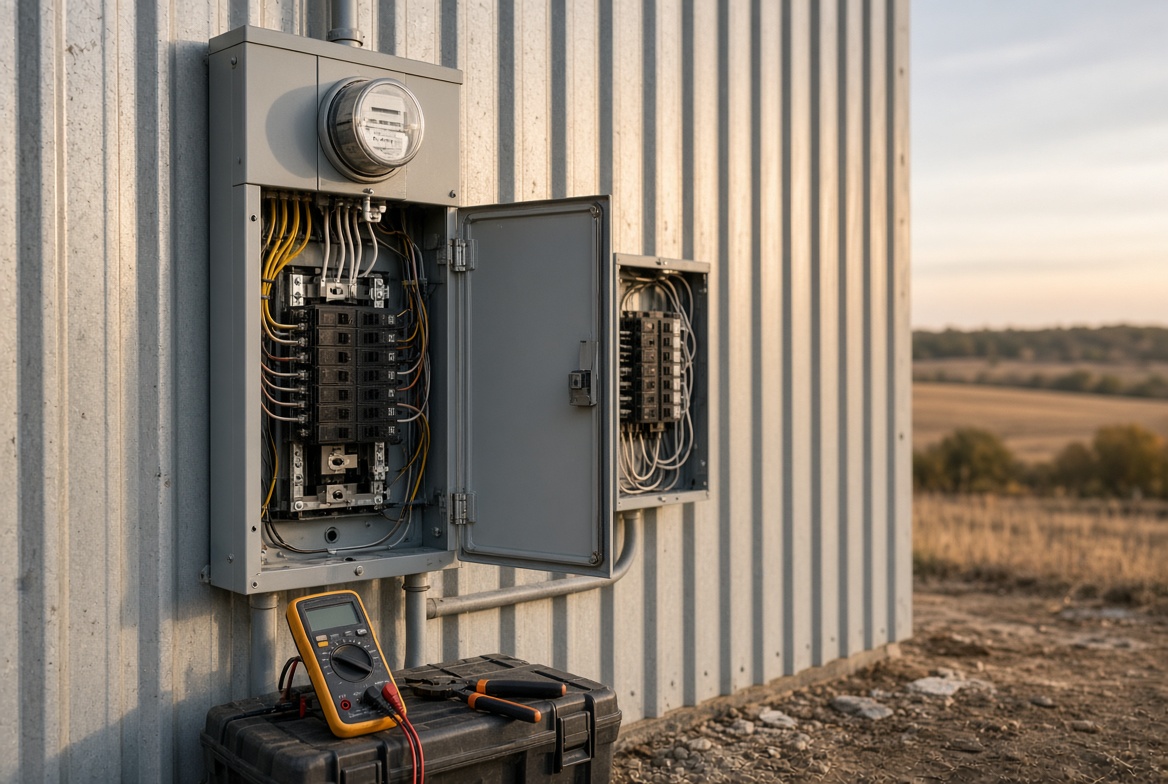
A 200-amp service — meter base, main panel, and the utility connection — runs $1,800–$3,500 for most barndominium builds. This is the smallest line item as a percentage of total barndominium electrical cost, but it’s not optional and it’s not negotiable on size: undersizing your service to save money here is the single most expensive mistake you can make, since upgrading later means trenching, a new meter base, and possibly a utility company site visit — all after you’ve already built around the smaller panel.
If your build includes a shop with welding equipment, large air compressors, or dust collection, size your service at 200 amps minimum and seriously consider 400 if the shop is substantial. The incremental cost of a bigger service at rough-in is a fraction of what it costs to upgrade after the walls are closed.
Rough-In Wiring Costs
Rough-in — running wire to every outlet, switch, and fixture location before drywall — is the largest single piece of your electrical budget, typically $3–$6 per square foot of living space. Several barndominium-specific factors push this toward the high end of that range:
- Open-concept lofts and vaulted ceilings — common in barndominium floor plans, these mean longer wire runs and more labor time on lifts or ladders compared to a standard 8-foot ceiling.
- Steel-specific labor — grommets and bushings at every stud penetration add time per run, even though the material cost is minimal.
- Shop bay wiring — 220V circuits for welders and large tools, plus higher-amperage outlets throughout, add both material and labor beyond a standard residential rough-in.
For the full sequencing, inspection, and steel-specific detail on this phase, see our complete electrical rough-in guide.
Finish Electrical Costs
Finish electrical — devices, switches, light fixtures, and any smart home components — runs $2–$4 per square foot. This is the stage where the cost range widens the most based on personal choice: builder-grade switches and a handful of ceiling fixtures sit at the low end, while a full smart-home package with app-controlled lighting, video doorbell wiring, and designer fixtures throughout can push well past the high end.
This is also the stage most owner-builders handle themselves, at least partially. Installing switches, outlets, and light fixtures once the rough wiring and panel work is done and inspected is straightforward work in most jurisdictions — check your local rules, but this is often where owner-builders capture real savings without touching licensed-only work.
Don’t let cost estimates replace inspection prep
Budgeting the number is only half the job — the free Rough-In Checklist covers what actually has to be right before your inspector shows up, so a passed inspection doesn’t cost you a change order later.
Labor vs. Material: Where Your Money Actually Goes
On a typical electrical bid, labor makes up roughly 50–60% of the total, with materials — wire, panels, devices, fixtures — making up the rest. Electrician labor rates have been climbing steadily; the U.S. Bureau of Labor Statistics reports a median annual wage for electricians well into the $60,000s nationally as of the most recent data, with meaningful regional variation. Rural Texas, Oklahoma, and Midwest labor rates typically run below coastal and major metro rates, which is part of why barndominium builds in those regions tend to land at the lower end of national cost ranges.
Sample Budget: 2,000 Sq Ft Barndominium Electrical
A realistic full electrical budget for a mid-grade 2,000 sq ft barndominium with an attached shop, owner-builder acting as their own GC:
| Line Item | Low Estimate | High Estimate |
|---|---|---|
| 200-amp service entrance and meter base | $1,800 | $3,500 |
| Rough-in wiring (2,000 sq ft) | $6,000 | $12,000 |
| 100-amp shop subpanel | $800 | $1,800 |
| Finish electrical (devices, fixtures) | $4,000 | $8,000 |
| Rural electric co-op hookup fee | $2,000 | $5,000 |
| Total | $14,600 | $30,300 |
The rural electric hookup fee is the line item most first-time owner-builders forget to budget separately — it’s a utility company charge for extending or connecting service to your property, and it’s not included in most contractor electrical bids. Confirm this cost directly with your local co-op before finalizing your budget.
Build your complete line-item budget
Electrical is one piece of the full build. The Rough-In Pack covers electrical, plumbing, and HVAC rough-in together — 88 line items sequenced in inspection order, plus sub-hiring question sheets so you know what to ask before you sign a contract.
Frequently asked questions
How much does it cost to wire a barndominium?
Total electrical cost — service entrance, rough-in wiring, and finish devices — typically runs $15,000–$28,000 for a 2,000 sq ft barndominium with a shop bay. Rough-in wiring alone, the largest single component, runs $3–$6 per square foot of living space.
Why is barndominium electrical more expensive than a stick-built house?
It usually isn’t more expensive on a per-square-foot basis, but a few factors push barndominium electrical costs toward the higher end of typical ranges: open-concept lofts and vaulted ceilings mean longer wire runs, shop bays require higher-amperage subpanels and 220V circuits, and steel framing requires grommets or bushings at every wire penetration, which adds labor time even though the parts themselves are inexpensive.
What’s the biggest factor in electrical material cost?
Copper. Copper wire pricing is historically volatile and has moved by double-digit percentages within single-year periods in recent cycles. Because copper wire is the largest material cost in most rough-in bids, a quote that’s more than a few months old may not reflect current pricing — always confirm current material costs before finalizing your budget.
Can I save money by doing my own electrical finish work?
In many jurisdictions, yes — installing switches, outlets, and light fixtures after the licensed rough-in and panel work is complete and inspected is straightforward work that owner-builders commonly handle themselves. Rules vary significantly by state and county, so confirm what’s allowed before you start; the licensed rough-in and panel work itself almost always requires a licensed electrician regardless of local rules on finish work.
Does a shop subpanel significantly increase electrical cost?
Yes, though it’s a worthwhile addition for most barndominium owners. A 100-amp shop subpanel runs $800–$1,800 for the subpanel itself, plus the cost of any 220V circuits for welders, large compressors, or dust collection equipment. Budget for shop electrical needs during your initial bid — retrofitting higher-amperage circuits after rough-in is complete costs significantly more than including them from the start.
See the complete barndominium cost guide for how electrical fits into your full project budget, or use the barndominium cost calculator to model your own numbers.